Every year, hundreds of thousands of people across Ontario begin their journey toward getting a driver's licence. Whether you are a teenager preparing for your first G1 test, a newcomer to Canada, or an adult finally deciding to drive, the Ontario G1 knowledge test is your first major step.
The problem is that many learners underestimate how difficult the test can be. They assume reading a few pages from the handbook is enough, only to fail because of confusing road sign questions, penalty rules, or right-of-way scenarios.
If you want to pass your Ontario G1 test on the first attempt, preparation matters. This complete guide explains everything you need to know about the Ontario G1 test, including study strategies, common mistakes, important rules, and proven preparation methods.
Quick Facts: Ontario G1 Test
- Questions: 40 total — 20 road signs + 20 rules of the road
- Passing score: 16/20 in each section (80%)
- Format: Multiple choice, computer-administered at a DriveTest centre
- Fee: Included in $158.25 licence application fee
- Retake wait: 24 hours, $15.75 retest fee
Watch: Ontario G1 Test Overview
What Is the Ontario G1 Test?
The Ontario G1 test is the written knowledge exam required before receiving a learner's licence in Ontario. It is administered at any DriveTest centre across the province and must be passed before you can drive on public roads, even with a licensed driver.
The exam evaluates whether you understand:
- Ontario road signs
- Rules of the road
- Safe driving practices
- Speed limits and zones
- Highway laws
- Penalties and fines
- Defensive driving principles
The test is divided into two sections. You must pass both sections to receive your G1 licence.
| Section | Questions | Passing Mark | Topics |
|---|---|---|---|
| Section 1 | 20 | 16/20 (80%) | Road signs — regulatory, warning, construction, school zone |
| Section 2 | 20 | 16/20 (80%) | Rules — right-of-way, speed limits, penalties, safe driving |
Why Many People Fail the Ontario G1 Test
One of the biggest reasons learners fail is because they memorize answers instead of understanding driving concepts. Ontario's G1 test includes many scenario-based questions such as:
- What should you do at a four-way stop?
- How far must you stop from a school bus?
- When can you pass another vehicle?
- What happens if an emergency vehicle approaches?
Another major issue is road sign recognition. Many learners struggle with warning signs, temporary construction signs, lane usage signs, and regulatory signs — particularly because the test uses images, not descriptions.
Top Reasons for G1 Failures
- Guessing on road sign shapes and colours instead of learning them
- Skipping the demerit point and penalty sections of the handbook
- Not practicing with realistic multiple-choice questions
- Misunderstanding right-of-way rules at intersections
- Rushing through questions without reading all answer options
Best Way to Study for the Ontario G1 Test
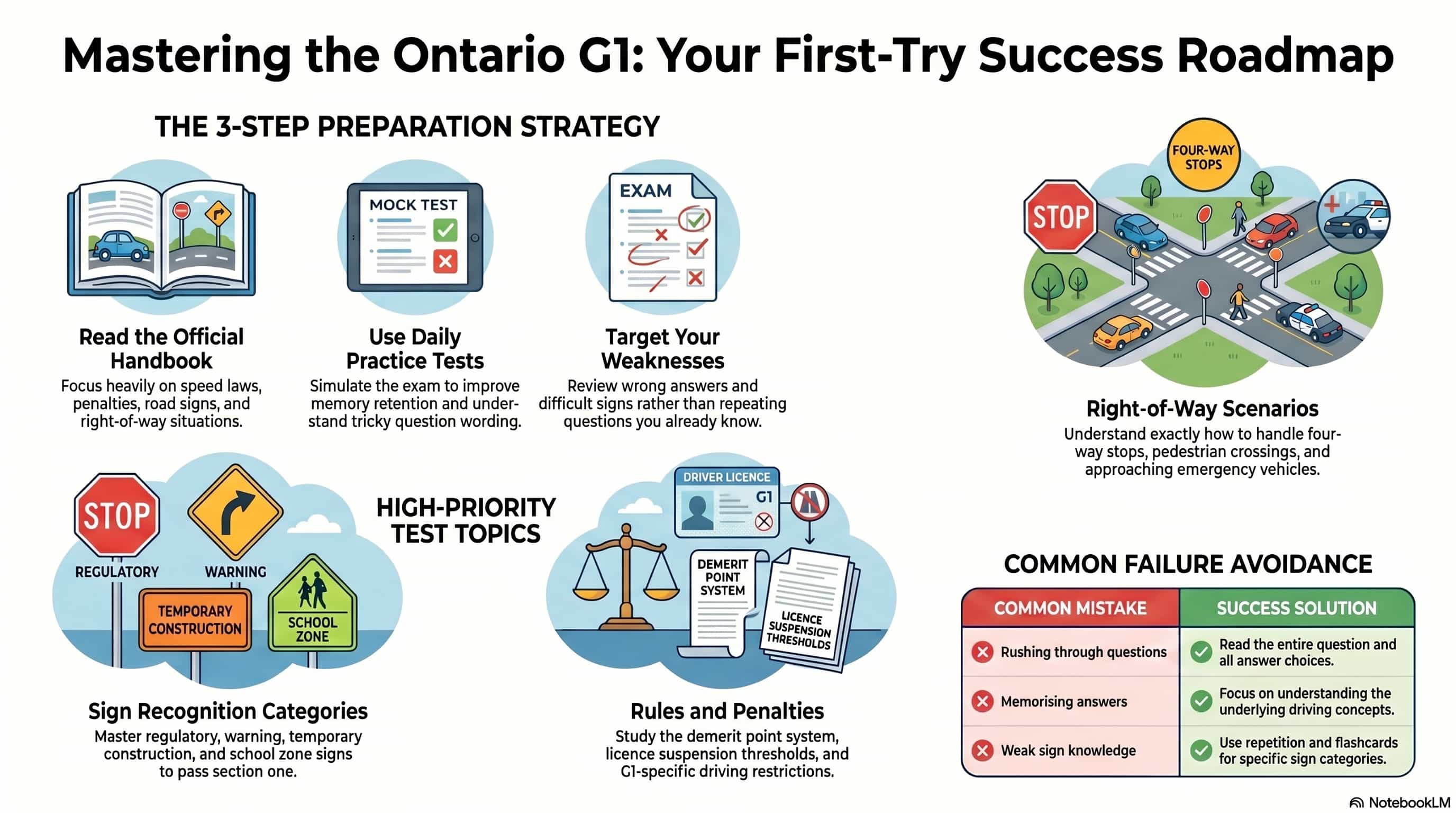
The most effective study strategy combines handbook reading with daily practice testing. Learners who spend at least five to seven days preparing consistently outperform those who cram the night before.
Step 1: Read the Ontario Driver's Handbook
The official MTO Driver's Handbook contains all the core material covered in the exam. Do not skip sections. Focus heavily on:
- Speed laws and community safety zones
- Penalties and demerit points
- Road signs (all chapters)
- Right-of-way situations
- Highway driving rules
- Parking regulations
- Alcohol and drug impairment rules
Step 2: Use Practice Tests Daily
Practice tests help learners understand question wording, improve memory retention, identify weak areas, and build confidence. The closer the practice test format matches the real exam, the better prepared you will be.
Free Ontario G1 Practice Tests
LicenceReady provides free Ontario-specific G1 practice tests covering road signs, rules of the road, and full challenge mode — designed to match the real DriveTest exam format.
Start Free Ontario G1 Practice Test →Step 3: Focus on Your Mistakes
Do not just repeat questions you already know. After each practice session, focus on wrong answers, difficult signs, confusing traffic laws, and penalty-related questions. This dramatically improves retention and fills the gaps that will cost you on the real test.
Most Important Ontario G1 Topics to Study
Road Signs
Ontario road signs are one of the biggest challenges for learners. The test presents sign images and asks you to identify their meaning. Important categories include:
- Regulatory signs (red and white — tell you what you must or must not do)
- Warning signs (yellow diamond — alert you to hazards ahead)
- Construction signs (orange — indicate work zones and temporary conditions)
- School zone signs (fluorescent yellow-green — protect children near schools)
- Parking restriction signs (combination of colours and arrows)
Speed Limits
Learners must understand the default speed limits in Ontario and when they change. Key areas include:
- School zones: 40 km/h when lights flash
- Community safety zones: doubled fines apply
- Highway limits: typically 100 km/h on 400-series highways
- Urban areas without posted signs: 50 km/h default
Demerit Points
Ontario uses a demerit point system for traffic offences. The test regularly asks about which violations result in specific demerit point values. Key areas:
| Offence | Demerit Points |
|---|---|
| Careless driving | 6 points |
| Racing / stunt driving | 6 points |
| Failing to remain at scene | 7 points |
| Speeding 30–49 km/h over limit | 4 points |
| Speeding 50+ km/h over limit | 6 points |
| Following too closely | 4 points |
| Failing to yield to pedestrian | 3 points |
| Distracted driving (hand-held device) | 3 points |
G1 Licence Restrictions to Know
- Must be accompanied by a fully licensed driver with 4+ years experience
- Zero blood alcohol level at all times
- No driving on 400-series highways (unless a licensed driving instructor is present)
- No driving between midnight and 5 AM
- All passengers must wear seat belts
Right-of-Way Rules
Right-of-way questions are among the most frequently tested topics on the Ontario G1 exam. Common scenarios include:
- Four-way stops: First to arrive goes first; if simultaneous, yield to the vehicle on your right
- Pedestrian crossings: Pedestrians always have the right-of-way at marked crosswalks
- Uncontrolled intersections: Yield to vehicles already in the intersection
- Emergency vehicles: Pull to the right and stop until the vehicle has passed
- School buses: Stop when red lights flash, in both directions on undivided roads
Common Ontario G1 Mistakes
Rushing Through Questions
Many learners fail because they read too quickly and miss a key word — "not," "except," "always," or "never." The Ontario G1 test is designed to test precision. Always read the entire question, review all four answer choices before selecting, and avoid making assumptions based on the first familiar-looking option.
Ignoring Practice Tests
Reading the handbook alone is usually not enough. The real exam uses specific phrasing and question structures that feel different from the text in the handbook. Practice testing improves familiarity with real exam patterns, helps you build test-taking stamina, and trains your brain to recall information under pressure.
Weak Road Sign Knowledge
Road signs are heavily tested on the G1 exam and many learners underestimate this section. Repetition is critical. Flashcard-style practice for road signs is one of the most effective preparation methods. Spend extra time on signs you confuse with each other — warning signs vs. regulatory signs, for example.
Ontario Driving Conditions You Should Understand
Ontario drivers face a variety of road conditions that the G1 test may reference, including:
- Winter driving: Snow, ice, reduced visibility, longer stopping distances
- Highway driving: Merging, lane changes, following distance at high speed
- Rural roads: Unmarked intersections, animals, gravel road hazards
- Construction zones: Reduced speed, fines doubled, workers present
- Urban congestion: Pedestrians, cyclists, transit vehicles, complex intersections
Understanding defensive driving techniques helps both during the test and real-world driving. Questions about hazard identification, following distance, and safe speed selection are common on the G1 exam.
Test Your Ontario G1 Knowledge Now
LicenceReady's free Ontario G1 practice tests cover road signs, rules of the road, demerit points, and more. No registration required — start immediately.
Take the Free Ontario G1 Test →Tips to Pass the Ontario G1 Test on Your First Attempt
Proven Study Tips
- Study in short daily sessions (20–30 minutes) rather than one long session
- Practice consistently for at least 5 days before your test date
- Focus extra time on road signs — use image-based flashcards
- Review every wrong answer and understand why it was wrong
- Sleep well the night before — fatigue significantly reduces recall
- Arrive at the DriveTest centre 15 minutes early to reduce stress
- Bring two pieces of ID and the required fee
Why Online Practice Tests Work
Modern learners perform better with interactive practice tools compared to passive reading. Online practice tests provide:
- Instant feedback — know immediately if your answer was correct and why
- Faster learning — active recall is more effective than re-reading
- Better retention — spaced repetition of wrong answers builds long-term memory
- Realistic simulation — format and difficulty match the actual exam
- Mobile-friendly studying — practice anywhere, any time
Consistent scores above 85–90% on practice tests indicate you are ready for the real Ontario G1 exam. If you are scoring below 80%, keep practicing before booking your test appointment.
Frequently Asked Questions
How many questions are on the Ontario G1 test?
The Ontario G1 knowledge test has 40 multiple-choice questions — 20 on road signs and 20 on rules of the road. You must correctly answer at least 16 in each section to pass.
What is the passing score for the Ontario G1 test?
You need to correctly answer at least 16 out of 20 questions in each section (80%) to pass. Failing either section — even if you pass the other — means you fail the whole test and must retake both sections.
How much does the Ontario G1 test cost?
The Ontario G1 knowledge test fee is included in the $158.25 driver's licence fee, which covers the knowledge test, vision test, and your first licence card. If you fail and need to retest, there is a $15.75 fee per attempt and you must wait at least 24 hours.
How long is the Ontario G1 licence valid?
The Ontario G1 licence is valid for 5 years. During this time you must progress through the Graduated Licensing System: holding G1 for at least 12 months (or 8 months with a recognized driving school course), passing the G2 road test, then eventually passing the full G road test.
Final Thoughts
Passing the Ontario G1 test is completely achievable with proper preparation. The key is consistency, understanding concepts, and practicing regularly — not cramming the night before.
Whether you are a first-time driver, a newcomer to Canada, or someone returning to driving after many years, the right preparation gives you confidence on test day and builds the foundation for safe driving throughout your life.
LicenceReady is designed to help Ontario learners practice smarter, improve faster, and increase their chances of passing the G1 test on the first try — completely free, with no registration required.
Ready to Start Preparing?
Take LicenceReady's free Ontario G1 practice tests right now. No sign-up. No cost. Just realistic practice questions designed to match the real DriveTest exam.
Start Free Ontario G1 Practice Test →